
1Where We Are Today
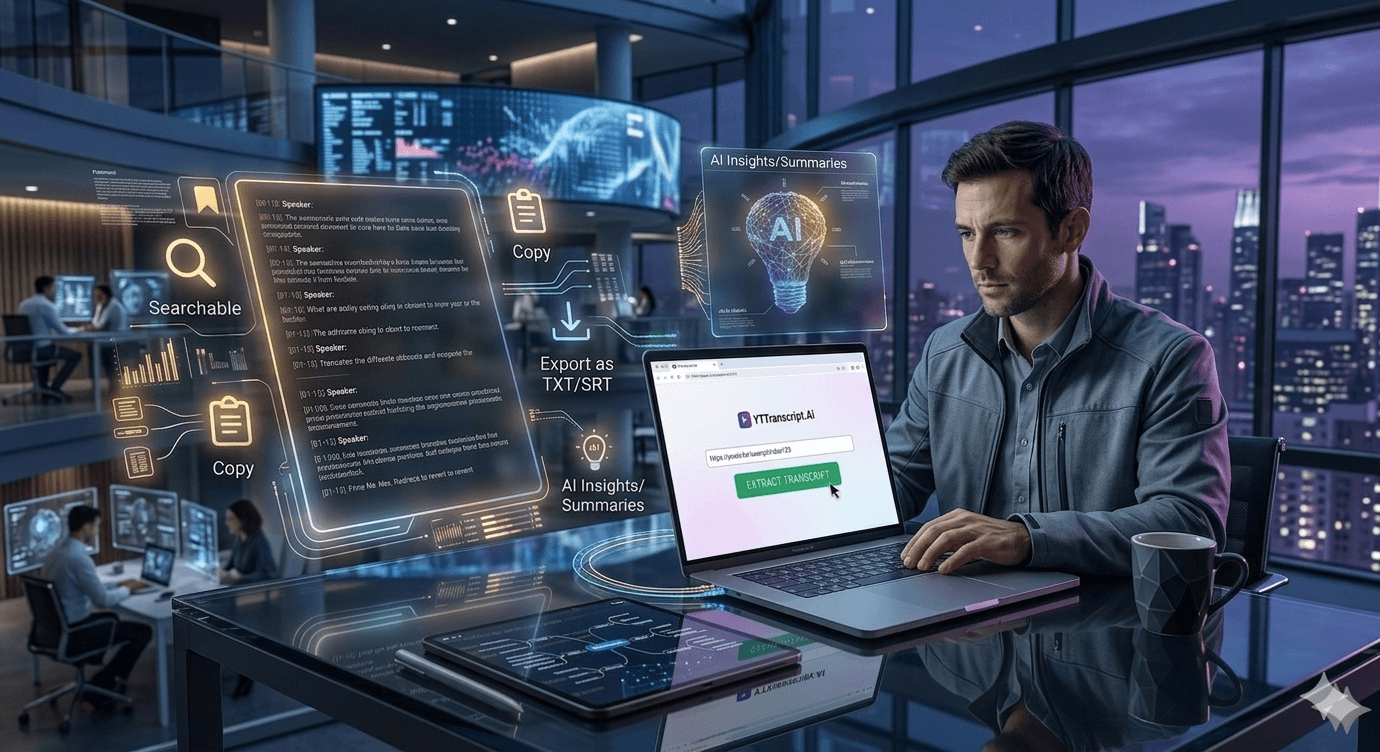
YouTube transcription in 2026 is remarkably capable. Auto-generated captions exceed 95% accuracy for clear speech. Tools extract and format transcripts in seconds. AI transforms raw text into summaries, articles, quizzes, and visual mindmaps.
But this is still early. The underlying technology — speech recognition, natural language processing, and generative AI — continues to improve at a pace that makes last year's capabilities feel primitive. Here is where things are heading.
2Near-Perfect Accuracy Across All Languages
Speech recognition accuracy for major languages (English, Spanish, Mandarin, Hindi) is already excellent. The next frontier is reaching the same accuracy for the thousands of languages and dialects that currently receive lower-quality auto-captions.
Multilingual AI models that can recognize and transcribe speech in any language without needing language-specific training are on the horizon. This will democratize transcription for speakers of underserved languages, making YouTube content universally accessible in text form.
3Speaker Diarization and Identification
Current transcripts attribute all text to a single unnamed speaker. Future transcription systems will automatically identify when different people are speaking and label each section with the speaker's name or role.
This matters enormously for interviews, panel discussions, podcasts, and meetings — any content with multiple speakers. Instead of a wall of undifferentiated text, you will get a properly formatted dialogue with each speaker identified. For researchers, this enables per-speaker analysis without manual coding.
4Real-Time Translation and Cross-Language Search
AI translation is already good, but it is currently a separate step — extract, then translate. Future systems will offer real-time translated transcripts as the video plays, in any language, without latency.
More importantly, cross-language search will let you search in your language and find results in videos in any language. Search for "climate change solutions" in English and find relevant segments in German lectures, Japanese documentaries, and Spanish interviews — all surfaced through AI translation of the underlying transcripts.
This capability will break down the last major barrier to a truly global knowledge base. Language will no longer determine which video content is accessible to which audiences.
5From Transcription to Understanding
The long-term trajectory of transcription technology is a shift from transcription (converting speech to text) to understanding (extracting meaning, intent, and insight from content).
We are already seeing early versions of this: AI summaries extract key points, mindmaps reveal conceptual relationships, and quizzes test comprehension. Future systems will go further — identifying arguments and counterarguments, detecting factual claims and checking them against evidence, summarizing consensus and disagreement across multiple videos, and generating new insights by connecting ideas across thousands of sources.
Transcription is the foundation. Understanding is the destination. Every improvement in accuracy, speed, and AI capability brings us closer to a world where the knowledge contained in video is as accessible, searchable, and useful as the knowledge in written text.