
1Speed Matters in Breaking News
A politician makes a controversial statement in a YouTube live stream. A CEO announces layoffs in a recorded all-hands meeting. A press conference reveals new details about a developing story. In each case, journalists need exact quotes — fast.
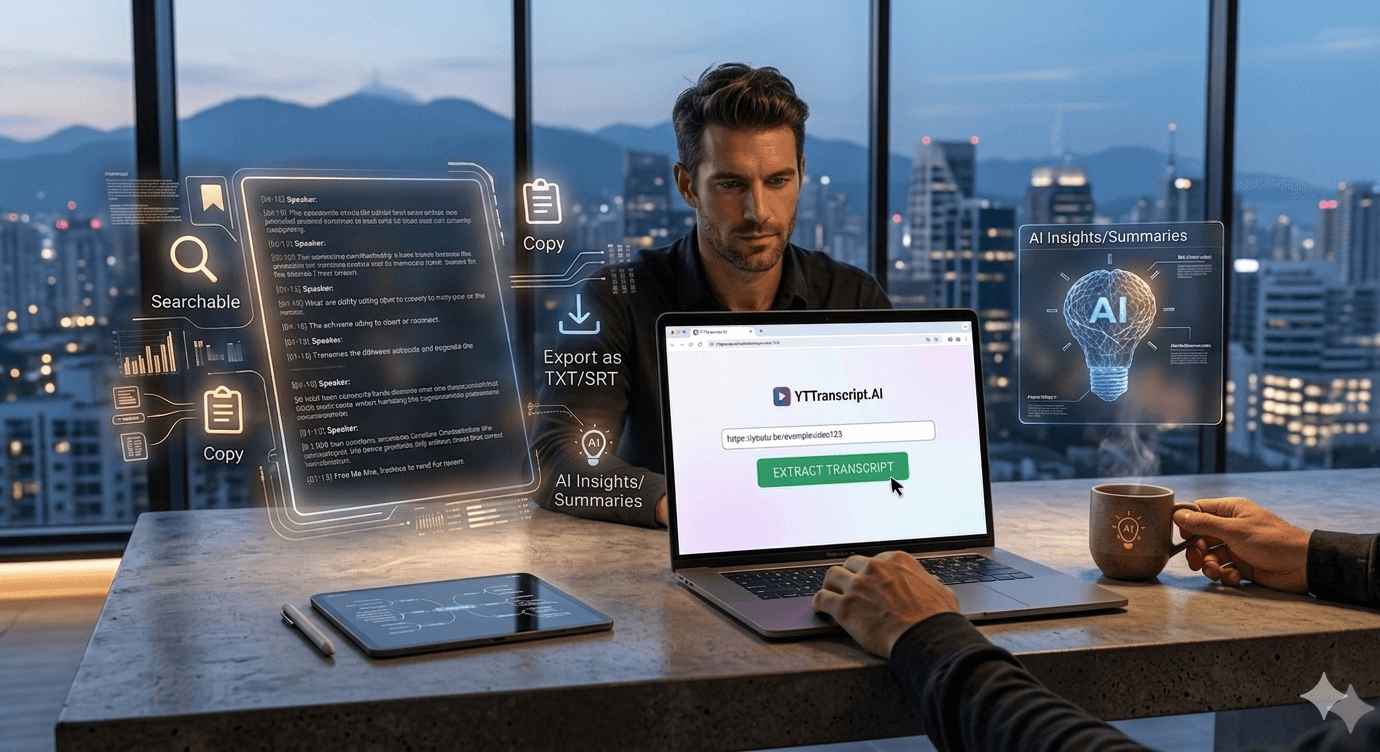
Traditionally, this meant scrubbing through video, pausing, rewinding, typing, verifying. For a 30-minute press conference, extracting quotes could take an hour or more. With transcript extraction, the entire spoken content is available as searchable text in seconds.
2Getting Accurate Quotes
Accuracy is non-negotiable in journalism. A misquote can damage credibility and invite legal trouble. YouTube transcripts extracted from the caption system provide near-verbatim text — but they are not infallible.
Best practice: extract the transcript and use it to quickly locate the relevant passage, then verify the exact wording against the video at the linked timestamp. This hybrid approach — search in text, verify in video — is dramatically faster than searching through video alone while maintaining the accuracy standard journalism requires.
3Searching Through Hours of Video Content
Investigative journalism often involves reviewing large volumes of video evidence — city council meetings, court proceedings, interview archives, campaign speeches.
With transcripts, this becomes a text analysis problem instead of a video watching problem. Extract transcripts from all relevant videos, then search across them for specific names, topics, or phrases. Find every time a public official mentioned a specific project. Track how messaging changed over time. Identify contradictions between statements made in different videos.
This capability transforms investigative workflows. What once required a team watching hundreds of hours of video becomes a single journalist searching through text.
Try It Yourself
Paste any YouTube URL below and get the full transcript with timestamps in seconds. Free, no sign-up required.
4Covering International Stories
Foreign-language video content is increasingly central to international reporting. Protests documented on YouTube, political speeches in foreign languages, international press conferences — all of this is primary source material that journalists need to access.
Extract the transcript in the original language, then use AI translation to convert it to your working language. The translation preserves context and meaning, giving you a working document for research and reporting. When quoting, reference both the original language and the translation to maintain accuracy.
This workflow means a single journalist can now meaningfully engage with video sources in any language, without waiting for a human translator.